Published 14 April 2026 in Press
Field hospital provides a form of collective emergency aid
Klyntji - Art
Published 31 March 2026
(Translated from Afrikaans to English using Google Translate)

Photos by Clifford Roberts and provided
A kind of wound report that brings healing
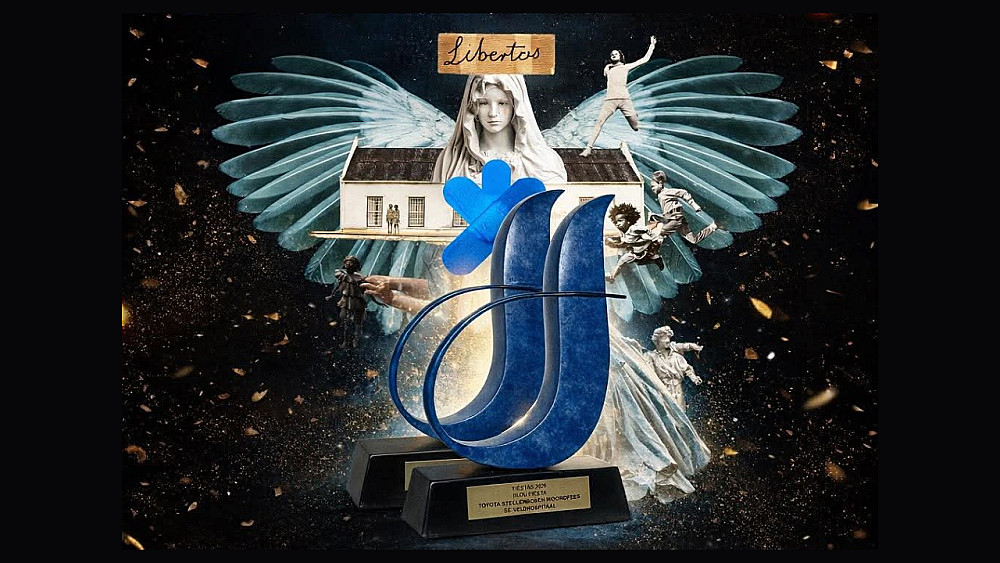
Last year at the Toyota Stellenbosch Woordfees, the unconventional art exhibition Field Hospital left deep traces – not just on canvas or paper, but in the minds of every visitor who moved through the space. It so moved the judging panel of the Fiëstas that in March this year they awarded this production a special Blue Fiësta. (Blue Fiëstas are awarded for meritorious work that does not fall into any of the categories.)
Field Hospital was a metaphorical place of healing – a place where wounds, both personal and collective, are examined, bandaged and sometimes left open to air and light.
According to the festival programme, Field Hospital is an experience, an adventure into the inner world, “a living work of art that arises from individual artists who each represent organs, body parts and abstractions of humanity”.
Field Hospital brings together various South African artists. Each artwork serves as a kind of wound report – an attempt to understand how people and communities continue to breathe after being torn open and torn apart by history, violence or change.
On my previous visit to Field Hospital, I drive down the dirt road to Libertas Farm outside Stellenbosch. Through the small opening in the whitewashed farm wall, I step into the space without knowing what I will feel or what to expect. The name Field Hospital already carries a kind of raw honesty – something between pain and hope, between breathing and continuing to live. Inside, the yard is silent; that kind of silence in which every footstep becomes a prayer. It forces you to tread more softly.
The exhibition divides the body into parts: The stomach is the field kitchen where you can order something to eat; other spaces depict the arms, hands, feet, head and emotions. (A full list of all the body parts, “hospital wards” and artworks can be seen here.) At each exhibition in this modern-day field hospital, a wooden clipboard hangs with the “patient’s” details, from ailment to prescription.
The exhibition in the various buildings on the farm consists of a variety of mediums: installations of hospital linen and plaster casts, video art depicting the silence of recovery and photography documenting traces of illness and war, but also the gentle hands of care. In one room, large canvases hang where rough brushstrokes express the turbulence of pain, while other smaller works whisper about intimate, quiet moments of humanity.
At the first outbuilding – the Scrubs Room – I meet fashion designers and stylists Bronwyn van den Berg (the womb) and Tracey Berg (the alter ego). Tracey's "symptoms" include searching for her inner Afrikaner, feeling incomplete and disempowered - she has an Afrikaans father from Vereeniging and an English mother raising her. Bronwyn's recycled clothes warn that you may need stitches to make yourself whole again.

Haidee Nel (arms and hands)'s Rooiborsduif – ode to Breyten Breytenbach

Above hangs a jellyfish from Lilah Nel's Grief and insomnia series, crocheted by Helena du Toit. The sculpture is by Haidee Nel.
Hanging over the farmhouse’s old lower door is Cedric October (the stomach and love handles), dressed in dishcloths. As I walk through the front room and look at the artwork, I realize that art itself can be a form of first aid.
Here I meet the poet Debbie Ryan (the head, or mind), a barefoot girl who treads more softly than most. She takes me through the rooms and gives a little background before we step out onto the site.
She explains that Field Hospital should be seen as a living sculpture. Artists represent different body parts and their art provides the medicine to cure the ailments that afflict those body parts. It is also a space in which the artists can support each other, where they can escape the pressure to create from ego and the competition for money.
She points to the Theatre behind the main house, where theatre and poetry are performed to visitors around campfires in the evenings. Here she performs her monologue ‘Donkerkamertjie’ daily.
She talks about the artists whose works I encounter: sculptors Haidee Nel (arms and hands), also known as Liefie; Jaco Sieberhagen (eye lens); musicians Luna Paige (emotions), Anele Jeanius and S.A.B.C 4 (feet and roots); Mia Nel (teeth); and Gert van Tonder (tears). Visual artists Trude Gunther represents the spleen and Seun op Aarde the intestines. Bernard Brand (lymph) is a photographer and Freek Oerson (pipes) does acting.

The entrance to Anele Jeanius (feet and roots) The untold story of a Jeanius

Katryn Meeding (the hippocampus)'s Dromer

Seun op Aarde's Trust your gut, skat
The entrance hall is adorned with works by other artists and on benches and chairs lie large lip-shaped cushions by Melissa Watson (lips), which remind us of how art as freedom of speech is essential for a country’s healing. Old newspaper clippings transformed into an artwork titled Basta! by Celeste Coetzee explore the place and role of the White Afrikaner woman.
In the old house’s living room, the Wagkamer, with wall paintings from centuries ago, I see an exhibition made by women in prison. It represents mental health and is the work of defenseless women who are victims of violence. Two mirrors show you which path you choose when you self-reflect – black mask on the right, white mask on the left. A symbol of how we decide which side of ourselves we show and which we hide.
I begin to understand. There is no dramatic music or bright light. Just the soft, continuous pulse of being human. Field Hospital is not a place where you just look – it is a place where you feel, where you remember how fragile and sacred we all are.
We pause at the end of the steps by the grass, where the words of Barbara Wildenboer (the mother tongue) are spelled out in white porcelain letters. The letters walk with you: “She dreams in the heart of the mountain; She breathes streams of water; She consumes the weather […].” (If you missed Field Hospital at last year’s Woordfees, you can see Wildenboer’s art this year at the 30th KKNK.)

The words of Barbara Wildenboer (the mother tongue) are spelled out in white porcelain letters.

Gert van Tonder's Tears/Tears aka liquid emotion. The visitor is invited to pour water over the stone as a kind of meditation.
Far back in the garden, where the gable of the historic house is visible through tree branches, we come to the weeping stone. It is Gert van Tonder’s Trane/tears aka liquid emotion, where the “symptoms” include: “[T]rane in my eyes: joy, sadness, silently teleporting through the window of your soul […].” His prescription: “Stare intently at the vortex, until tears flow. Many drops together make an ocean.”
In the outbuildings – the Sanatorium – there is art in every corner, but it feels as if the artists in the old cement vats where tartaric acid makes the walls sparkle ruby red, are creating their own drama. A few who stand out are tattoo artist Tamara Thorn-Murphy, who depicts her breast cancer journey with nipples of different sizes and textures. She divides her work into two parts: the hurtful, thoughtless comments from people about her diagnosis, and the positive words she clings to. She realizes that hair, appearance and breasts are secondary – the fact that her life is the most precious. Lilah Nel's (insomnia and grief) Grief and Insomnia series creates a dream world of insomnia, but also of tranquility for the visitor.

Lilah Nel's (insomnia and grief) Grief and insomnia series in the Sanatorium

Haidee Nel's Swartskapie in the Sanatorium

Rignold Haywood (the nervous system) invites the visitor to develop new neuropathways by playing with colour and sound in his interactive liquid light show The begotten, and the sound element – Orbaphone, the 9 note tongue drum.
I crawl through the opening of the whitewashed wall with its plastic with a blue patch on it again, and meet Haidee Nel, sculptor and co-director of the project. She tells us that artists want to heal together with visitors. Themes such as loss of identity, the trauma of displacement and the ongoing attempt at reconciliation resonate strongly with the current South African zeitgeist. She describes the project as “an emergency tent for the soul” – a place where art offers first aid for emotional wounds that are not always seen.
We all hide in isolation and believe we are alone, but this exhibition reminds us that our pain and healing are always a collective experience. Field Hospital makes you realise that art does not always have to be beautiful; it can hurt, reveal and ultimately heal. Too soon we leave. The healing process barely begins, but the effect resonates for a long time. Here artists share their wounds about loss, memory and the broken land in which we all lie waiting to breathe. You can participate, or stand by indifferently.
Keep an eye on veldhospitaal.com for when you can next visit this mental asylum.

Haidee Nel, one of the participating sculptors and co-director of the project, at the entrance to Field Hospital where it was set up last year during Woordfees at the Libertas farm.
To view the original article please navigate to the Klyntji website here